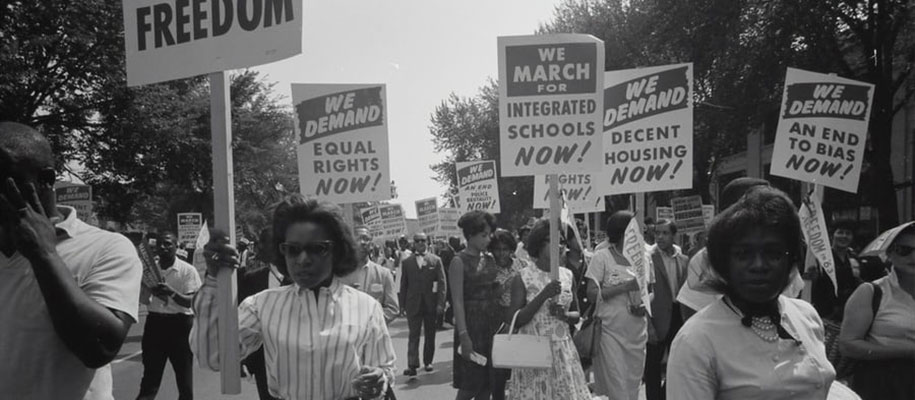
February is Black History Month, a time to honor the achievements and anguish Black people in America have experienced in the past as well as the present. Did you know February was chosen to celebrate because it’s the month Abraham Lincoln and Frederick Douglass were born? There’s an endless amount to learn and reflect on, with more history in the making every day.
Read on to explore some of the most significant moments in Black history over the past 200 years, including historical milestones in the field of education—though this list of events is just a drop in the bucket.
1830
The Abolitionist Movement is organized in an effort to end slavery in the US, causing great friction between slave-owning states in the South and anti-slavery states in the North. Among many achievements is the Underground Railroad, a secret network of safe houses that was established to help enslaved people escape to free states.
April 12, 1861
The American Civil War begins at Fort Sumter in South Carolina, starting the Union’s years-long fight against the Confederacy to abolish slavery.
January 1, 1863
The Emancipation Proclamation is issued by President Abraham Lincoln during the third year of the Civil War, stating that people enslaved in Confederate states “shall be then, thenceforward, and forever free."
April 9, 1865
Robert E. Lee surrenders the last major Confederate army to Ulysses S. Grant, effectively ending the Civil War.
June 19, 1865
Union soldiers arrive in Galveston, Texas, to let residents know slavery has been abolished. This day of celebration is also known as Juneteenth, Emancipation Day, and Black Independence Day, among other names.
December 6, 1865
The 13th Amendment to the United States Constitution is ratified, officially ending the institution of slavery.
July 9, 1868
The 14th Amendment to the Constitution gives Blacks equal protection under the law.
February 3, 1870
The 15th Amendment gives Black men in America the right to vote.
Related: Impactful Ways to Celebrate Black History Month
1877
The Supreme Court rules that states cannot prohibit racial segregation on public modes of transportation such as trains, streetcars, and boats. This begins an era of Jim Crow laws that were used to maintain segregation through the 1960s.
1896
The US Supreme Court endorses the doctrine of “separate but equal” in Plessy v Ferguson.
February 12, 1909
The National Association for the Advancement of Colored People (NAACP) is established in New York in an effort to abolish all segregation and enforce the 14th and 15th Amendments, among other goals.
1920
The Harlem Renaissance starts a revival of music, art, dance, literature, theater, and other Black and African American cultures in New York City through the mid-1930s.
June 18, 1940
A federal court rules Black and White teachers must be paid equal salaries in Alston v School Board of City of Norfolk.
May 17, 1954
The Supreme Court overturns Plessy v Ferguson, ruling it as inherently unequal, in Brown v Board of Education.
December 1, 1955
Rosa Parks is arrested after refusing to give up her seat at the front of a bus in Montgomery, Alabama, defying segregation laws that state Black passengers must sit in the back.
November 14, 1956
The Supreme Court rules that segregated seating is unconstitutional.
September 4, 1957
Nine Black students integrate an all-White high school in Little Rock, Arkansas, and are barred from school on the first day by Governor Orval Faubus. Later that month, the Little Rock Nine would be escorted to school by federal troops at the request of President Dwight D. Eisenhower, drawing more attention to the Civil Rights Movement.
September 9, 1957
President Eisenhower signs the Civil Rights Act of 1957 into law, allowing anyone who tries to prevent someone from voting to be federally prosecuted.
February 1, 1960
Four Black students at North Carolina Agricultural & Technical College in Greensboro refuse to leave the lunch counter at Woolworth’s after being denied service, starting a sit-in movement throughout college towns in the South and forcing the general store and other businesses to change their policies.
November 14, 1960
At only six years old, Ruby Bridges becomes the first Black student to integrate into a White elementary school in the South.
1962
The University of Mississippi (Ole Miss) admits Black student James Meredith after he wins a lawsuit stating he was discriminated against based on race, causing a mob scene during his first day on campus in which two people were killed and 200 more were wounded. The University of Alabama also desegregates after Governor George Wallace literally blocks a Black student from the admission office with state troopers. Wallace is later forced to integrate the University after President John F. Kennedy deploys National Guard troops to campus; two Black students enroll the next day.
August 28, 1963
The March on Washington for Jobs and Freedom is held with approximately 250,000 activists gathering at the Lincoln Memorial in protest of unequal rights, including Dr. Martin Luther King Jr., who gives his famous “I Have a Dream” speech to close out the event.
Related: 5 Great Recommendations for Books by Black Authors
July 2, 1964
President Lyndon B. Johnson signs the Civil Rights Act of 1964, guaranteeing equal employment, ensuring public spaces are integrated, addressing the desegregation of schools, outlawing discrimination in federally funded programs, and prohibiting general discrimination on the basis of race, color, religion, sex, or nation of origin.
1965
The Elementary and Secondary Education Act is created to offer federal aid toward equal opportunity efforts. Congress also passes the Voting Rights Act of 1965, further protecting Black voter rights by banning literacy tests and other discriminatory practices at state and local levels.
April 4, 1968
At 39 years old, Dr. Martin Luther King Jr. is assassinated on his hotel balcony in Memphis, Tennessee, inciting riots across the country.
June 28, 1969
The Stonewall Uprising began when New York City police raided the Stonewall Inn, a gay club in Greenwich Village. The raid sparked a riot in the streets and served as a catalyst for the gay rights movement, a series of protests led by a Black transgender woman named Marsha P. Johnson and bolstered by many other Black and Brown activists of the time.
February 1976
President Gerald Ford officially recognizes the first Black History Month, which originated from “Negro History Week” created by civil rights leader Carter G. Woodson.
June 28, 1978
The Supreme Court rules that racial quotas in higher education are unconstitutional but maintains a college’s right to factor race into admission decisions in Regents of the University of California v Bakke.
November 1983
President Ronald Reagan signs a bill declaring Martin Luther King Jr. Day a national holiday, though it isn’t celebrated as a federal holiday until 1986 or officially adopted by all 50 states until the year 2000.
March 18, 1996
Affirmative action is ceased at public universities in Texas when the appeals court rules that the use of race in higher education admission decisions is prohibited in Hopwood v Texas, the first successful legal challenge to a university’s affirmative action policies.
2003
In Grutter v Bollinger, the Supreme Court declares that while race can still play a factor in admission decisions at the University of Michigan to promote diversity, point systems for minority applicants are deemed unconstitutional. In the same year, Harvard University conducts a Civil Rights project that finds schools were more segregated in 2000 than in 1970 when legitimate desegregation efforts began.
November 4, 2008
Barack Obama is elected as the 44th president of the United States, becoming the first Black man to hold the office.
2012
#BlackLivesMatter is first used on social media after George Zimmerman is acquitted of 17-year-old Trayvon Martin’s murder. The movement grows across the country and around the world after 18-year-old Michael Brown is shot six times by a White police officer in 2014.
2016
The Supreme Court upholds affirmative action at the University of Texas at Austin in Fisher v UT Austin.
May 25, 2020
Following other high-profile cases—such as the March 13 murder of Breonna Taylor in her own home—the Black Lives Matter Movement explodes again when 46-year-old George Floyd dies after being pinned to the ground by policeman Derek Chauvin.
November 3, 2020
Kamala Harris becomes the first woman—and first woman of color—to serve as Vice President when Joe Biden is elected President.
June 17, 2021
President Biden signs a bill declaring Juneteenth as a federal holiday.
2022
The Supreme Court plans to review affirmative action in higher education in cases involving Harvard and the University of North Carolina.
June 29, 2023
The Supreme Court rules that race-conscious admission policies at Harvard and UNC are unconstitutional, effectively ending affirmative action in college admission across the country. This decision reshapes how colleges consider diversity in their application processes.
August 5, 2024
Vice President Harris makes history again by becoming the first Black woman to secure a major party's nomination for President of the United States. After President Biden decides not to seek re-election, Harris receives the Democratic Party's endorsement to lead the ticket in the 2024 presidential election.
November 5, 2024
For the first time in US history, two Black women are elected to the US Senate: Lisa Blunt Rochester from Delaware and Angela Alsobrooks from Maryland. Blunt Rochester becomes both the first woman and the first Black senator elected in Delaware, while Alsobrooks becomes Maryland's first Black senator.
February 9, 2025
At Super Bowl LIX in New Orleans, Grammy-winning artist Ledisi performs "Lift Every Voice and Sing," often referred to as the Black national anthem. This marks the fifth consecutive year the song is featured at the NFL championship, reflecting ongoing recognition of its cultural significance.
Related: School Spotlight: 7 Non-HBCUs That Support Black Students
We hope you enjoyed reading about some of the most significant milestones in Black history. There is so much more to learn that we couldn’t cover here, and we hope you’ll continue to do so this month and beyond.
Remember, the most important source for learning is from Black voices, stories, and causes—and a great place to start is blackhistorymonth.gov. Help uplift the Black community in any way you can to work toward a more just and equitable future. Happy Black History Month!
Interested in learning about important people in the history of Black culture more in-depth? Check out our Heroes of History article on 5 Unsung Black Male Figures.